
Understanding Working Memory Issues in Children With ADHD
Homeschooling a child with Attention Deficit Hyperactivity Disorder (ADHD) comes with unique rewards and challenges.
One of the most common and frustrating challenges is working memory issues. Working memory is the brain’s ability to hold information temporarily while using it to complete a task.
It allows children to remember instructions, follow multi-step directions, and stay focused while learning.
Research shows that working memory issues affect nearly 70–85% of children with ADHD, according to studies published in the Journal of Attention Disorders.
RELATED: What Is Living With ADHD Really Like? A Real Look at Adult ADHD and Daily Life
DOWNLOAD: The 4-Page ADHD Focus Reset Guide (Free!)
These challenges can make homeschooling feel overwhelming, both for parents and children.
A child may genuinely want to complete a task but still forget instructions halfway.
This is not laziness or lack of interest. Instead, it reflects neurological differences in how the ADHD brain processes
and stores information.Understanding this challenge is the first step toward building effective learning strategies.
How Working Memory Issues Affect ADHD Homeschooling
Working memory problems often appear in daily homeschooling routines. Children may:
- Forget multi-step instructions
- Lose track of assignments
- Struggle to complete tasks independently
- Feel frustrated or discouraged during learning
- Need frequent reminders to stay focused
According to the Centers for Disease Control and Prevention (CDC), children with ADHD commonly struggle with executive functioning skills, including memory, planning, and organization.
Without structured support, these difficulties can impact academic confidence and emotional well-being.
Fortunately, practical teaching adjustments can significantly improve learning outcomes.
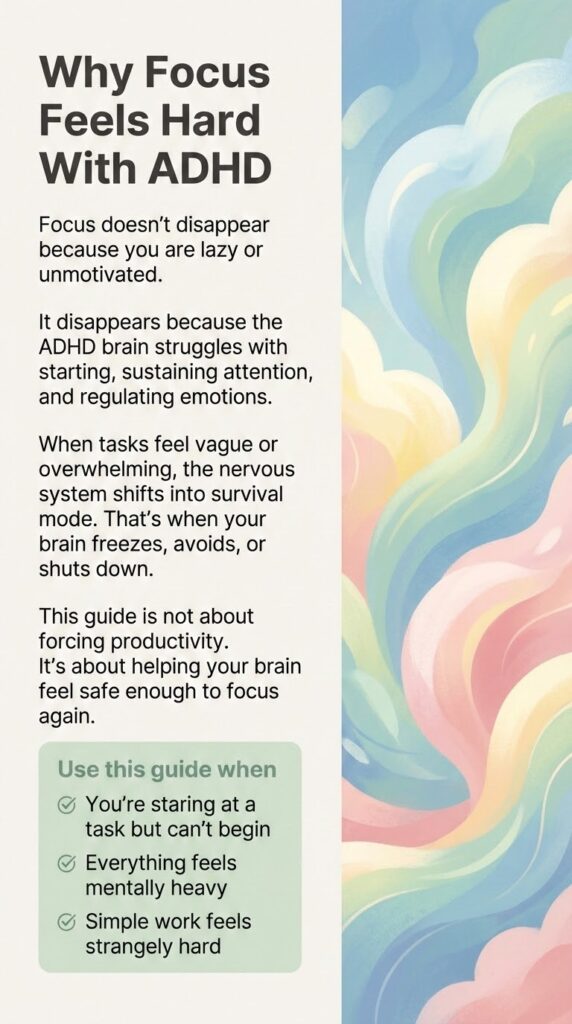
DOWNLOAD: The 4-Page ADHD Focus Reset Guide (Free!)
12 Proven Tips to Help ADHD Children Overcome Working Memory Issues
1. Break Instructions Into Small, Manageable Steps
Long instructions can overwhelm working memory. Breaking tasks into smaller steps makes them easier to follow.
For example, instead of saying, “Finish your worksheet and organize your folder,” divide it into separate actions. This reduces mental overload and increases task completion success.
Research from the Child Neuropsychology Journal suggests that smaller instruction sets improve accuracy and retention in children with ADHD.
2. Use Visual Checklists for Daily Learning Tasks
Visual reminders reduce the need to remember instructions mentally. Checklists provide clear structure and independence.
Parents can create:
- Subject-based task lists
- Daily routine charts
- Reward-based completion trackers
Visual cues act as external memory support, helping children stay organized.
3. Ask Children to Repeat Instructions Back
Repeating instructions strengthens understanding and retention. After giving directions, gently ask the child to explain the steps in their own words.
This technique reinforces memory processing and ensures clarity before starting tasks.
4. Combine Verbal and Written Instructions
Using both spoken and written directions increases memory retention. Children with ADHD benefit when information is presented through multiple channels.
Effective methods include:
- Writing instructions on whiteboards
- Using sticky notes for reminders
- Providing printed assignment steps
Multi-sensory instruction improves learning consistency.
5. Create Predictable Learning Routines
Routine reduces working memory demands because children know what to expect. Predictable schedules help learning become automatic.
A consistent daily homeschool routine might include:
- Morning reading sessions
- Midday math practice
- Afternoon creative learning
Studies from the American Academy of Pediatrics highlight routine as a powerful tool for improving executive functioning in children with ADHD.
6. Use Timers to Support Task Completion
Timers help children stay aware of time and transitions. ADHD learners often struggle with time management and task persistence.
Short timed sessions, such as the Pomodoro technique, can improve focus. This involves working for 20–25 minutes followed by a short break.
Visual timers are especially helpful because they provide a clear sense of time passing.
7. Introduce Color-Coded Learning Systems
Color coding helps children visually organize information and recall tasks easily. Parents can assign different colors for each subject.
Examples include:
- Blue folders for math
- Green notebooks for science
- Yellow sticky notes for reminders
Color associations create memory anchors that guide children during learning.
8. Encourage Verbal Self-Guidance
Self-talk strengthens working memory by helping children stay mentally organized. Teaching children to speak steps aloud while completing tasks improves concentration.
For instance, a child solving math problems might say each step out loud while working through it. This technique supports sequential thinking.
9. Schedule Frequent Movement Breaks
Working memory performance declines when children feel mentally fatigued. Physical activity improves focus and memory retention.
Short movement breaks may include:
- Stretching exercises
- Jumping activities
- Short outdoor walks
According to research published in Frontiers in Psychology, physical activity significantly improves cognitive performance in children with ADHD.
10. Use Hands-On and Interactive Learning Tools
Interactive learning strengthens memory retention by engaging multiple senses. Hands-on tools help children remember instructions better than passive learning methods.
Useful tools include:
- Flashcards
- Manipulatives for math
- Educational games and puzzles
Multi-sensory learning creates stronger neural connections.
11. Reduce Environmental Distractions
Distractions increase working memory overload. A clutter-free and quiet learning environment helps children stay focused.
Parents can:
- Remove unnecessary desk items
- Use noise-canceling headphones
- Maintain consistent study locations
A calm learning environment supports concentration and reduces forgetfulness.
12. Celebrate Small Learning Successes
Children with ADHD often struggle with self-confidence due to repeated memory challenges. Celebrating progress builds motivation and resilience.
Parents can praise effort, consistency, and improvement instead of focusing only on results. Positive reinforcement encourages persistence and emotional growth.
Why Supporting Working Memory issues Is Essential in ADHD Homeschooling
Working memory influences nearly every academic skill, including reading comprehension, writing organization, and math problem-solving. Without support, children may fall behind despite strong intelligence and creativity.
Early intervention and supportive teaching strategies help children develop independence and learning confidence. Homeschooling provides flexibility that allows parents to tailor instruction based on individual cognitive needs.
Frequently Asked Questions About ADHD Working Memory issues and Homeschooling
What causes working memory issues in ADHD?
Working memory challenges occur due to differences in brain development, particularly in areas responsible for executive functioning and attention control.
Can working memory improve over time?
Yes. With structured support, consistent routines, and skill-building strategies, children can strengthen working memory abilities.
How can parents know if memory challenges are affecting learning?
Signs include frequently forgetting instructions, struggling with multi-step tasks, losing school materials, and needing repeated reminders.
Are working memory difficulties related to intelligence?
No. Many children with ADHD have average or above-average intelligence. Memory challenges are neurological processing differences, not ability limitations.
Final Thoughts
Working memory issues can make homeschooling a child with ADHD feel exhausting and emotionally challenging. However, when parents use structured routines, visual supports, and patience, children develop stronger learning skills and confidence.
Progress may appear gradual, but consistent support leads to meaningful improvement. Homeschooling allows families to create flexible learning environments that honor the child’s unique brain and learning style.
By focusing on understanding rather than pressure, parents can help children with ADHD build lifelong learning success.
